thoughts on big walk
communication is key • monday, september 7 2026this post contains spoilers for big walk and the finale of the game. if you haven't yet, i encourage you to buy the game and try it out with some friends. it's worth it.
communication is something i value a lot. not everyone holds it to the same regard as i do, but being able to sincerely share my feelings with my loved ones is something that i consider a requirement for my well being. contradictorily, i don't consider myself that good at it. i've never been diagnosed but i've often wondered if i have dyslexia. i definitely have some form of adhd. my thoughts often are scrambled and my attempts to convey them don't fare much better. i have reservations about putting myself in leadership roles because while i am capable of formulating a plan and acting on my own thoughts, my lengthy and scatterbrained explanations leave a lot to be desired.
all of this is to say, i didn't think i'd come away with such a positive feeling after finishing the final act of big walk, a game predicated entirely on your ability to talk through puzzles with a group of your friends.
when i first saw the reveal trailer at the 2023 geoff keighley game awards, i didn't think much of it. it felt like a game capitalizing on the recent trend of cooperative, laid-back multiplayer games (coloquially known as "friendslop" -- hate that term) presented with environment art that looked prototypical and unfinished. the faux gamer-chatter over the trailer didn't help my feelings towards it, and i tuned out until the name drop... when i noticed that big walk was created by house house, a studio which saw success with their prior work, untitled goose game. like big walk, goose game's premise, silly and benign as it may be, belied it's incredibly charming game design and presentation. i went "oh! those are the goose game guys!" and then it fell out of my short term memory to be forgotten about until launch.
suffice to say, big walk became a very popular game at launch and deservedly so!
i played big walk in a group of 5, largely composed of members of my polycule. it became evident that our group had a lot of "problem solvers" in it early on. every puzzle had everyone chiming in with their own solution, and solving puzzles was less about solving anything with an intuitive plan and more about deciding on whose intuitive plan we were to try first. it was hectic and created a bit of friction, but with time we learned to trust in eachother's decision making and commit to a plan together. it required us to put away our egos a bit, which is surprisingly difficult to do, lol...
being that our group was slightly larger than the 4 that the puzzles in the game were designed for, we often split up. not every puzzle required 4 people to participate, creating interesting interstitials where the group would seperate to explore the immediate area and radio in when we found something that did require the entire group's presence to solve. it was these moments that i realized the genius of big walk's design not just as a puzzle game but as a social game.
there are moments where the game expects you to be separated into smaller groups. interestingly, design decisions like needing another player to grab items from your belt or backpack ensure that it is always ideal to be travelling with at least one other person, but other decisions like the gondola cars seating no more than 2 at a time guarantee that players will inevitably find themselves paired together and feel inclined to make small talk. this experience was mundane but incredibly delightful, a feeling that has largely feels squeezed out of the average multiplayer game's lightning round matchmaking that lasts for 15 minutes at a time and often limits communication for fear of online toxicity. it had me recalling when game servers were things that orbited smaller online communities, rather than catch-all "fandoms" that include the entire playerbase and are often poorly moderated -- if moderated at all.
up until the finale, the game had a silly, comedic and mostly unserious vibe that doesn't challenge the player's expectations much. our group never got that snagged on any one puzzle for an extended period of time, but they always felt novel enough to maintain our intrigue throughout. eventually, everyone is funneled towards a rather intimidating black monolith, entrance of which is only permitted once enough pre-requisite puzzles are completed surrounding the towers that landmark the island. just entering the top floor requires 4 players to be present, and opening the door causes just 1 player (of which i was fortunate enough to be selected) to receive a surreal and creepy vision of the final area of the game, a liminal space consisting entirely of concrete, contrasting the natural foliage of the rest of the setting. vitally, open mic stays on during this entire sequence, so my friends were rather concerned as i started to talk about seeing visions of the stark grey, brutalist construction of the final area. it was a cool moment; just another way the game's design encourages communication. it would've been easy to show everyone this sequence, but by limiting it to just one player, the group is forced to wonder just what the hell is up ahead based solely on one friend's verbal description.
the final area's gimmick is probably easy to predict if you think about how puzzles have been presented up to this point -- players lose their ability to communicate through verbal means, and everyone loses their perception of color such that all players in the lobby appear identical. the group is forced to communicate solely through visual means, without language or identity. none of the puzzles are that complex, but the sheer limitation imposed on the players and the construction of the final area makes it feel oppressive. the game hints at what's to come by imposing these same restrictions without a puzzle in an earlier area, so our group decided early on that we would have gestures for "yes" and "no" -- communicated using the controllable limbs of the player characters (in our case, arms up: yes, arms out: no.) this wound up being vital in the final area, and saved us a lot of hassle in the first puzzle. the mood was somber at times, being forced into total silence -- but even this didn't totally prevent extraneous communication from happening. raising your arms rapidly in the "yes" motion quickly became synonymous with "yay!", done celebratorily following the successful completion of a puzzle, and we began mashing the mute and menu buttons to maintain some levity (opening the menu or muting subtly changes the player's appearance and made a silly audible sound that wasn't muted in the final area.) all of this struck me as a little bit profound that even without language we could find ways to at least communicate our feelings.
the final floor of this area has you disabling the machine that was preventing the group from communicating, and what immediately followed was eager discussion about the challenges we faced and identifying who was who during the entire process. i eagerly talked about just how cool the entire experience was. like most good puzzle games, big walk's puzzles are never insurmountable but they always make you feel smart, gently guiding the player to the correct decision subtly.
the epilogue of the game has you watch the credits together on an in-game theater, sat on a couch next to the group you just spent silently solving puzzles with for the last 20 or so minutes, giving you an opportunity to further discuss your feelings. still reeling from just how novel the entire sequence was, i was eager to gush about how it made me feel while names of the big walk developers scrolled by. finally, the last area of the game instructs you to wave good bye. players leave the area one by one by entering a one way gate in a sequence i found myself getting intensely emotional at -- after the previous challenges, it felt incredibly bittersweet to say our farewells like this, just after completing several puzzles that required intense improvisational communication and trust in eachother. the game ends with one final message from the developers.
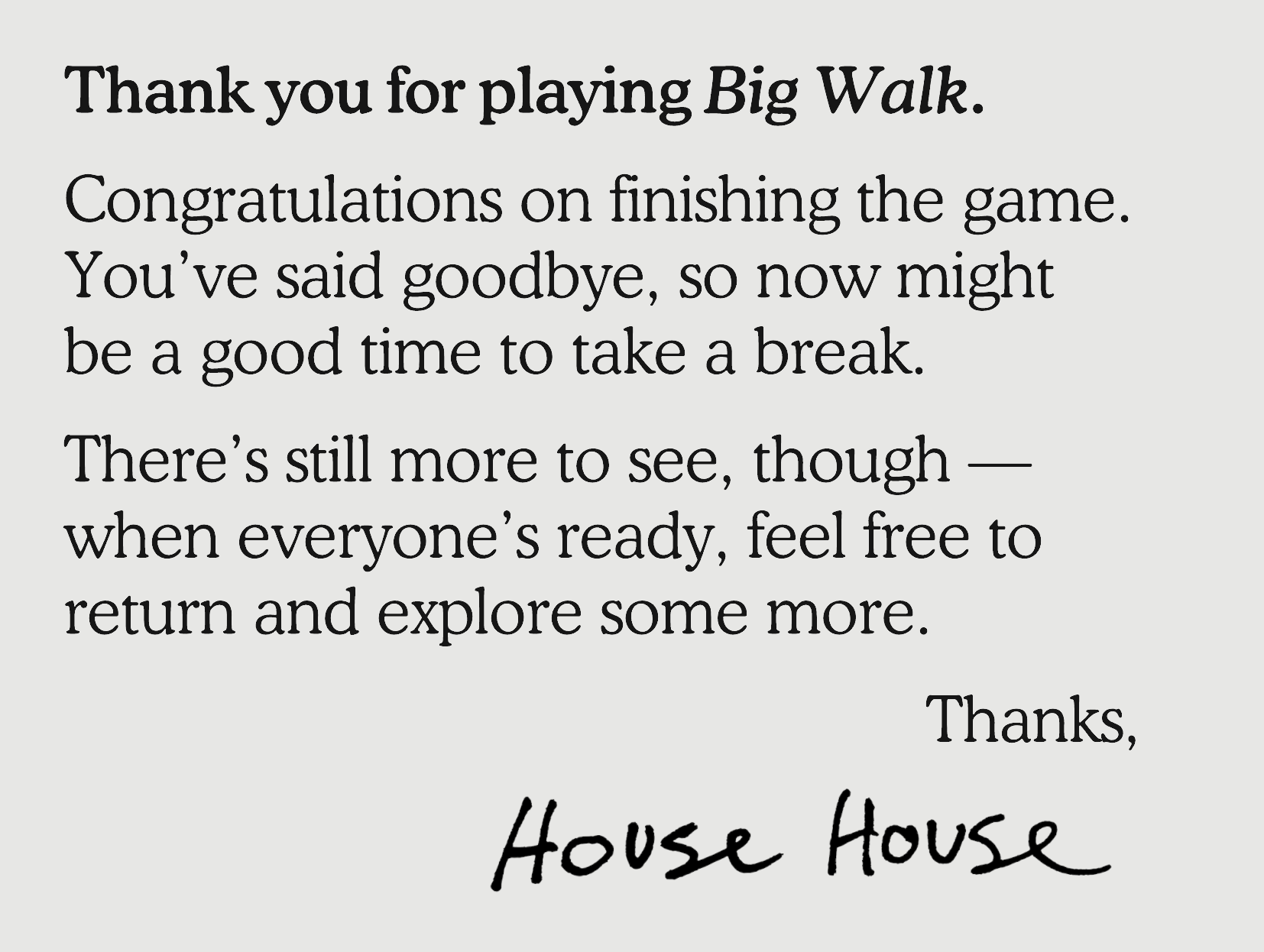
i was probably letting my emotions get the better of me. of course, all of us were in a discord call and unmuted following the ending to further discuss. i have the emotional fortitude of a wet napkin, it's not that hard to get me to start crying about a silly puzzle game like this.
i guess i felt the need to write all this because big walk was a really impactful piece of art to me. video games often today feel a bit anti-social, even multiplayer ones. playing something that was eager to push me and my friends together and give us an opportunity to talk about our lives and what's been happening within in a low stakes environment is something you just don't get a lot of anymore. i hope the success of big walk encourages other developers to build games with a heavier focus on the kind of relationship building communication that made me so endeared to it, because i'd love to play more of this kind of game in the future.